
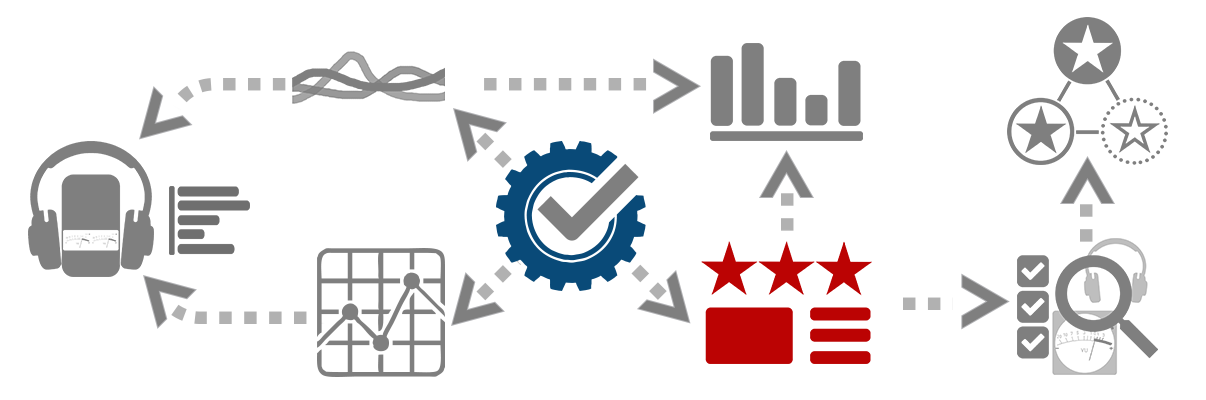
After testing in the benchmark mode in the Reference Audio Analyzer software, the data is added to the online database of the RAA website.
You can view the test results on the comparison pages and summary reports for beginners
 and professionals. You can go to the desired report or comparison/selection service through the menu on this page. Additionally, you can go to the comparison pages from any graph in this report and add other tested products for direct comparison.
This is a rating summary report of interaction with amplifier sources and external conditions for "dummies"
You can also view other summary reports for HiFiMan HE-400 Leater Ear Pads
You can view the test results on the comparison pages
and summary reports for beginners and professionals. You can go to the desired report or comparison/selection service through the menu on this page. Additionally, you can go to the comparison pages from any graph in this report and add other tested products for direct comparison.This is a rating summary report of interaction with amplifier sources and external conditions for "dummies"
You can also view other summary reports for HiFiMan HE-400 Leater Ear Pads
- Main professional characteristics report
- Compatibility with amplifier sources - graphs
- Recommendations for equalization and comparison with target curves
- List of similar models by frequency response
- Simple report for "dummies" with explanations of the main characteristics
- Compatibility with amplifier sources and external conditions for "dummies"
Analogy of the report
For example when choosing a video card, many people do not understand the set of tables with the final data of the test packages. How to understand the relative difference in these figures? In most cases, the unprepared reader is satisfied with only the textual evaluation of the author, without delving into the figures. When the choice of a product is done thoroughly, then the reader gradually deepens into complex tables, mastering information from simple to complex. We made two separate reports: "simple" and "complex". A simple report with explanatory comments will allow you to self-study to gradually understand and professional report.In this report, information is presented as simply and clearly as possible. Interpretation of data is maximally simplified, and, accordingly, devoid of subtleties and nuances. This is sufficient for an overall assessment, but for a more complete and accurate presentation should be considered a professional type report
.
By possible, the characteristics are accompanied by explanations to do reader possibility gradually master a more complex professional report of HiFiMan HE-400 Leater Ear Pads.
Analysis with recommendations for HiFiMan HE-400 Leater Ear Pads headphones based on the measured characteristics
About the recommendations table
The table shows the most common "typical" audio sources and the field of application of headphones with an amplifier.
The compatibility rating is similar to car analysis by its clearance. When we know clearance we can estimate which type of road will optimally for that car without evaluating the class of the car. On a race car of Formula 1 is difficult to drive on a ground road. The same foolish idea to use caterpillar all-terrain vehicle on a highway.
To assess the compatibility of the sensitivity of the headphones and the power of the headphone amplifier, we assume that the user will listen to music at a comfortable volume level of 90 dB SPL
For final calculations, an additional 9 dB correction is added, because music is usually uneven in volume and louder short sections are often found, but we still perceive the overall volume as averaged. Thus, the final reference sound pressure is 99 dB SPL, perceived as 90 dB SPL.
Additionally, it is taken into account that sometimes the user may want to listen to music louder or, conversely, quiet recordings with a wide dynamic range (this gives an addition to the volume in calculations of 24 dB) and an estimated sound pressure of 123 dB SPL.
Depending on the external conditions, this volume varies, and we evaluate in which conditions the source will play in high-quality mode, and in which there will be a lack of volume, unnecessary distortion or other negative factors.
Detailed description formula of the table of headphones
In a professional way, the assessment of the compliance of the sensitivity of headphones to the characteristics of the amplifier is done through the comparison service voltage and sensitivity or the simpler service sound pressure in a bundle.
The compatibility rating is similar to car analysis by its clearance. When we know clearance we can estimate which type of road will optimally for that car without evaluating the class of the car. On a race car of Formula 1 is difficult to drive on a ground road. The same foolish idea to use caterpillar all-terrain vehicle on a highway.
To assess the compatibility of the sensitivity of the headphones and the power of the headphone amplifier, we assume that the user will listen to music at a comfortable volume level of 90 dB SPL
For final calculations, an additional 9 dB correction is added, because music is usually uneven in volume and louder short sections are often found, but we still perceive the overall volume as averaged. Thus, the final reference sound pressure
is 99 dB SPL, perceived as 90 dB SPL.
Additionally, it is taken into account that sometimes the user may want to listen to music louder or, conversely, quiet recordings with a wide dynamic range (this gives an addition to the volume in calculations of 24 dB) and an estimated sound pressure of 123 dB SPL.
Depending on the external conditions, this volume varies, and we evaluate in which conditions the source will play in high-quality mode, and in which there will be a lack of volume, unnecessary distortion or other negative factors.
Detailed description formula of the table of headphones
In a professional way, the assessment of the compliance of the sensitivity of headphones to the characteristics of the amplifier is done through the comparison service voltage and sensitivity
or the simpler service sound pressure in a bundle.
Analysis of acoustic design HiFiMan HE-400 Leater Ear Pads
Thus, in order to assess the compatibility of audio sources with HiFiMan HE-400 Leater Ear Pads in voltage and current, a calculation is made for the possibility of providing a maximum sound pressure level of 123 dB SPL for a quiet environment and 135 dB SPL for noisy, with subjective listening to music in conditionally ideal conditions of 90 dB SPL.
If we consider not a general case, but an individual one, where each listener has his own music and his own environment, then you can determine your reference level independently and already evaluate everything for him. You can set your own reference level in all relevant RAA tools.
If we consider not a general case, but an individual one, where each listener has his own music and his own environment, then you can determine your reference level independently
and already evaluate everything for him. You can set your own reference level in all relevant RAA tools.
Analysis of the sensitivity of HiFiMan HE-400 Leater Ear Pads headphones
Depending on the sensitivity of the headphones, a certain voltage is required from the amplifier to get the desired final volume.
At the same time, if the source is too "powerful", then there is a high probability of constantly hearing background noise, and if weak, then there will be insufficient volume. In relation to the concept of volume, it is customary to use the word "power", but in fact only voltage is responsible for the volume level. The rating in the form of stars depends on two conditions, the maximum and minimum voltage that the amplifier gives.
Since we perceive the difference in volume not linearly, but in multiples, not only the final sound pressure is expressed in dB SPL instead of Pa (Pascal), but similarly the voltage instead of VRMS is expressed in dBV. A 6 dB change is a multiple of the voltage doubling. A person can subjectively distinguish a difference in volume of 1 dB.
In a quiet environment, to obtain a subjective 123 dB SPL with a voltage sensitivity of 108.576 dB/V SPL from an amplifier, a voltage of 14.42 dBV is required. For a noisy environment 26.42 dBV. These are the minimum voltages that the amplifier should provide in high-quality mode.
The list of suitable amplifiers according to the calculated data for 14.42 dBV can be viewed on the comparison page of the parameters of the amplifiers measured in RAA according to the parameters: the minimum voltage of 14.42 dBV for the impedance of the connected headphones is 43 ohms.
But an amplifier with excessive volume is undesirable, otherwise, with a small signal-to-noise ratio at the desired comfortable volume level, background noise will be heard during pauses, or it will be difficult to adjust the volume with the effect of channel imbalance. For each amplifier tested in RAA, a parameter such as the optimal volume control range is assigned. According to this condition, the amplifier will receive the maximum rating if its maximum level, minus the optimal volume control range, is lower than the calculated optimal sound pressure.
For example, for an amplifier with an optimal adjustment range of 50 dB for a sound pressure of 99 dB SPL in a quiet environment, its maximum voltage should not be higher than 40.42 dBV.
The list of suitable amplifiers according to the initial parameters can be viewed on the comparison page of the parameters of the amplifiers measured in RAA according to the parameters: gain quality class "No Current Limit", maximum voltage 40.42 dBV for the impedance of the connected headphones 43 Ohms.
At the same time, if the source is too "powerful", then there is a high probability of constantly hearing background noise, and if weak, then there will be insufficient volume. In relation to the concept of volume, it is customary to use the word "power", but in fact only voltage is responsible for the volume level. The rating in the form of stars depends on two conditions, the maximum and minimum voltage that the amplifier gives.
Since we perceive the difference in volume not linearly, but in multiples, not only the final sound pressure is expressed in dB SPL instead of Pa (Pascal), but similarly the voltage instead of VRMS is expressed in dBV. A 6 dB change is a multiple of the voltage doubling. A person can subjectively distinguish a difference in volume of 1 dB.
In a quiet environment, to obtain a subjective 123 dB SPL with a voltage sensitivity of 108.576 dB/V SPL from an amplifier, a voltage of 14.42 dBV is required. For a noisy environment 26.42 dBV. These are the minimum voltages that the amplifier should provide in high-quality mode.
The list of suitable amplifiers according to the calculated data for 14.42 dBV can be viewed on the comparison page of the parameters of the amplifiers measured in RAA
according to the parameters: the minimum voltage of 14.42 dBV for the impedance of the connected headphones is 43 ohms.
But an amplifier with excessive volume is undesirable, otherwise, with a small signal-to-noise ratio at the desired comfortable volume level, background noise will be heard during pauses, or it will be difficult to adjust the volume with the effect of channel imbalance. For each amplifier tested in RAA, a parameter such as the optimal volume control range
is assigned. According to this condition, the amplifier will receive the maximum rating if its maximum level, minus the optimal volume control range, is lower than the calculated optimal sound pressure.
For example, for an amplifier with an optimal adjustment range of 50 dB for a sound pressure of 99 dB SPL in a quiet environment, its maximum voltage should not be higher than 40.42 dBV.
The list of suitable amplifiers according to the initial parameters can be viewed on the comparison page
of the parameters of the amplifiers measured in RAA according to the parameters: gain quality class "No Current Limit", maximum voltage 40.42 dBV for the impedance of the connected headphones 43 Ohms.
Analysis of the impedance of HiFiMan HE-400 Leater Ear Pads headphones
The average impedance of HiFiMan HE-400 Leater Ear Pads headphones is 42.74 ohms.
The impedance affects the amount of current that the amplifier should give to the headphones. If there is not enough current, then the sound quality will deteriorate, starting with sharpness in the sound and ending with a banal wheeze. In most cases, at low current values, the amplifiers operate in a linear mode comparable to Class A quality, and with an increase in current output, the quality decreases towards the nonlinear mode and the clipping zone.
Imagine that you have a tank that is gradually filling with water. The voltage at the amplifier is the pressure with which the pump pumps water out of the tank. If the water inflow in the tank is lower than the volume that the pump pumps out, then at the pump outlet we get "bubbles" along with the water. Similarly, with the sound from the headphones, which did not have enough current from the amplifier.
For the example above, to obtain a maximum sound pressure of 123 dB SPL for a quiet environment, an amplifier with an output current level of at least 3123.13 41.81 dB(mA) is desirable for the HE-400.
For a loud environment, a sound pressure of 135 dB SPL will require 490.19 mA / 53.81 dB(mA).
Five stars in the recommendation table are given to those amplifiers that have a sufficient margin in terms of output current.
For an unbalanced connection, the amount of headphone impedance affects the antiphase mixing of channels.
The impedance affects the amount of current that the amplifier should give to the headphones. If there is not enough current, then the sound quality will deteriorate, starting with sharpness in the sound and ending with a banal wheeze. In most cases, at low current values, the amplifiers operate in a linear mode comparable to Class A quality
, and with an increase in current output, the quality decreases towards the nonlinear mode and the clipping zone.
Imagine that you have a tank that is gradually filling with water. The voltage at the amplifier is the pressure with which the pump pumps water out of the tank. If the water inflow in the tank is lower than the volume that the pump pumps out, then at the pump outlet we get "bubbles" along with the water. Similarly, with the sound from the headphones, which did not have enough current from the amplifier.
For the example above, to obtain a maximum sound pressure of 123 dB SPL for a quiet environment, an amplifier with an output current level of at least 3123.13 41.81 dB(mA) is desirable for the HE-400.
For a loud environment, a sound pressure of 135 dB SPL will require 490.19 mA / 53.81 dB(mA).
Five stars in the recommendation table are given to those amplifiers that have a sufficient margin in terms of output current.
For an unbalanced connection, the amount of headphone impedance affects the antiphase mixing of channels
.
Other summary reports for HiFiMan HE-400 Leater Ear Pads headphone
More detailed
Measurements of HiFiMan HE-400 Leater Ear Pads were carried out by Roman Kuznetsov on the hardware-software complex RAA.
The HiFiMan HE-400 Leater Ear Pads test was conducted as a black box test, without regard to cost and prestige. This is the basic principle for making measurements, measurement reports and developing tests in RAA.
I believe that it is important to do not make an absolute assessment of the device, but an aggregate assessment when working together with a source amplifier and taking into account external factors. This allows you to effectively reveal the potential of the entire set of devices or to make a more optimal choice of components.

Kuznetsov Roman
Founder of RAA
Information for Authors. You can freely use the graphics in your articles with a link to us.
it is a translation from the Russian language. Original text in Russian page.
You can help us with the correct translation into English.